

What Is Headphone Impedance and Why It Matters for Your Sound
Have you ever wondered why the cheap earbuds that came with your phone sound quiet and terrible when you plug them into a professional mixing board? Or why your expensive studio headphones are practically useless when connected to your laptop? The answer is a single, often misunderstood number: impedance.
Getting this right is the difference between a clean, powerful monitor mix and a distorted, disappointingly quiet signal. It’s a fundamental concept, but one that trips up even experienced musicians and technicians.
Think of impedance, measured in ohms (Ω), as the amount of resistance a pair of headphones puts up against the audio signal. It’s like a gatekeeper controlling the flow of electrical power from your audio source (like a mixer or headphone amp) to the tiny speakers inside your headphones.
The Dangers of a Mismatch
Ignoring the impedance for headphones isn't just about getting bad sound—it can have real consequences for your gear and, more importantly, your hearing.
Practical Example 1: Disappointing Volume: You plug your new high-impedance Beyerdynamic DT 990 Pro (250Ω) headphones into your smartphone to check a reference track. The phone simply can't generate enough voltage to "push" through that high resistance, leaving you with a signal that's far too quiet to be useful.
Practical Example 2: Distortion and Damage: Now, let's try the opposite. You connect a pair of low-impedance earbuds (maybe 32Ω) to the powerful headphone output on a professional mixer. The mixer can easily overwhelm the headphones with too much current, leading to harsh, crackly distortion and potentially frying the delicate voice coils inside. This is a costly and easily avoidable mistake.
Hearing Safety: An improper match can also cause unexpected and dangerously loud volume spikes. This is a serious risk, especially in a live environment where you’re trying to protect your most valuable asset—your ears.
The core principle is simple: professional equipment requires professionally matched gear. The standard earbuds that came with your phone are not built for the powerful outputs of an Allen & Heath mixer. They are designed for completely different electrical environments.
Matching Impedance to Your Gear
To make this easier, here is a quick reference for matching impedance ranges to your audio source. Finding the right impedance for headphones ensures you get the clean, powerful sound you expect from your setup.
| Impedance Range | Best For | Practical Use Cases & Devices |
|---|---|---|
| Low (Under 50Ω) | Maximum volume from low-power devices. | Smartphones, laptops, portable music players, and wireless in-ear monitor (IEM) packs. |
| Medium (50Ω – 100Ω) | Versatile use across consumer and pro gear. | Studio interfaces (like a Focusrite Scarlett), drum machines, and some mixers. A great all-rounder. |
| High (Over 100Ω) | Detailed audio from high-power sources. | Professional studio mixers, high-end headphone amps, and dedicated monitoring stations for FOH engineers. |
At John Soto Music, we help you find the perfect match. Whether you need durable, high-impedance cans like the Beyerdynamic DT 770 Pro for your mixing console or reliable, low-impedance Shure SE215 IEMs for stage performance, our curated selection of road-tested gear has you covered.
To really get a handle on why headphone impedance matters so much in today's audio world, you have to look back. The whole concept wasn't invented just to give musicians and sound techs a headache; it was a smart engineering fix for the limitations of early electronics. At its core, impedance has always been about making things work as efficiently as possible.
This story starts way before the first electric guitar was ever plugged in, back in the clatter of early telephone switchboards. Headphones weren't for entertainment—they were critical tools for communication.
The Dawn of High Impedance
Back in the late 19th and early 20th centuries, audio signals were incredibly weak. The first headphones, created around 1891 by French engineer Ernest Mercadier, were for telephone operators who needed their hands free. When wireless radio took off in the 1910s, these designs had to be adapted for low-power crystal sets. This pushed impedances way up, often into the 1,000 to 2,000-ohm range, just to squeeze every last drop of volume out of a tiny amount of power.
You can explore more about the early days of headphone technology and its progress over the years.
This high-impedance design wasn't a choice; it was a necessity. It was the only way to get an audible sound from the very low voltage coming out of early tube-based gear, ensuring operators and radio hobbyists could actually hear what was going on.
The Studio Standard Is Born
Now, let's jump forward to the golden age of recording studios in the 1970s and '80s. Huge analog mixing consoles were the heart of every studio, and they had powerful, high-voltage headphone amplifiers built right in. These consoles were designed to drive a whole bunch of headphones at once for the entire band and the engineering team.
This is where legendary high-impedance headphones, like the Beyerdynamic DT 770 Pro (250 ohm), became the undisputed workhorses of the industry. Their design gave them a few massive advantages in a pro studio setting:
- Durability: The finer voice coils in high-impedance headphones were tougher. They were much less likely to get fried by the beefy headphone outputs on a professional mixing desk.
- Consistency: When you plug several pairs of headphones into one amp, higher impedance helps keep the volume level more consistent across all of them. No one's ears get blasted while someone else can barely hear.
- Perfect Match: These headphones were literally engineered to work with the high-voltage, low-current outputs that were standard on studio gear. The result was clean, detailed audio without distortion.
This historical connection is exactly why high-impedance headphones are still a staple in professional audio. They were built for the powerful, centralized systems found in recording studios and live sound rigs—the same kinds of systems we rely on today.
This legacy is what directly shapes the pro gear we recommend and sell at John Soto Music. The same engineering principles that made a 250-ohm headphone the right call for a 1980s studio console are the same principles that make it a perfect match for a modern Allen & Heath digital mixer. It’s proof that solid engineering stands the test of time, connecting yesterday's breakthroughs with the demands of today's live shows, worship services, and school bands.
Matching Your Headphones to Your Audio Gear
Ever wonder why your favorite headphones sound incredible plugged into your phone but disappointingly quiet when you plug them into a professional soundboard? Or maybe the opposite—they sound great at the mixing desk but distort horribly with your laptop.
This isn't a problem with your headphones. It’s an electrical mismatch, and it all comes down to a single, critical spec: impedance. Getting this right is the key to unlocking the performance your gear was designed for.
Low Power vs. High Power Sources
The answer lies in the power output of your audio source. Think of it like a garden hose: your phone has a small nozzle with low pressure, while a professional mixer is like a fire hydrant. You need the right attachment for each.
Low-Impedance Headphones (Under 50Ω): These are built for low-power devices like smartphones, laptops, and tablets. They need very little electrical "push" (voltage) to get loud, which makes them perfect for your everyday listening. But plug these into the powerful headphone output of a mixer like an Allen & Heath Qu series, and that fire hydrant of voltage will overwhelm the delicate drivers, leading to harsh distortion and even permanent damage.
High-Impedance Headphones (100Ω and above): These are the professional-grade cans, built to handle the high-voltage outputs of studio consoles and dedicated headphone amps. Their higher resistance demands more power. If you connect them to a low-power source like a laptop, there just isn't enough juice to drive them properly. The result? The audio sounds thin, weak, and frustratingly quiet.
This helpful infographic shows how headphone impedance has evolved over the decades to meet the demands of different audio technologies.
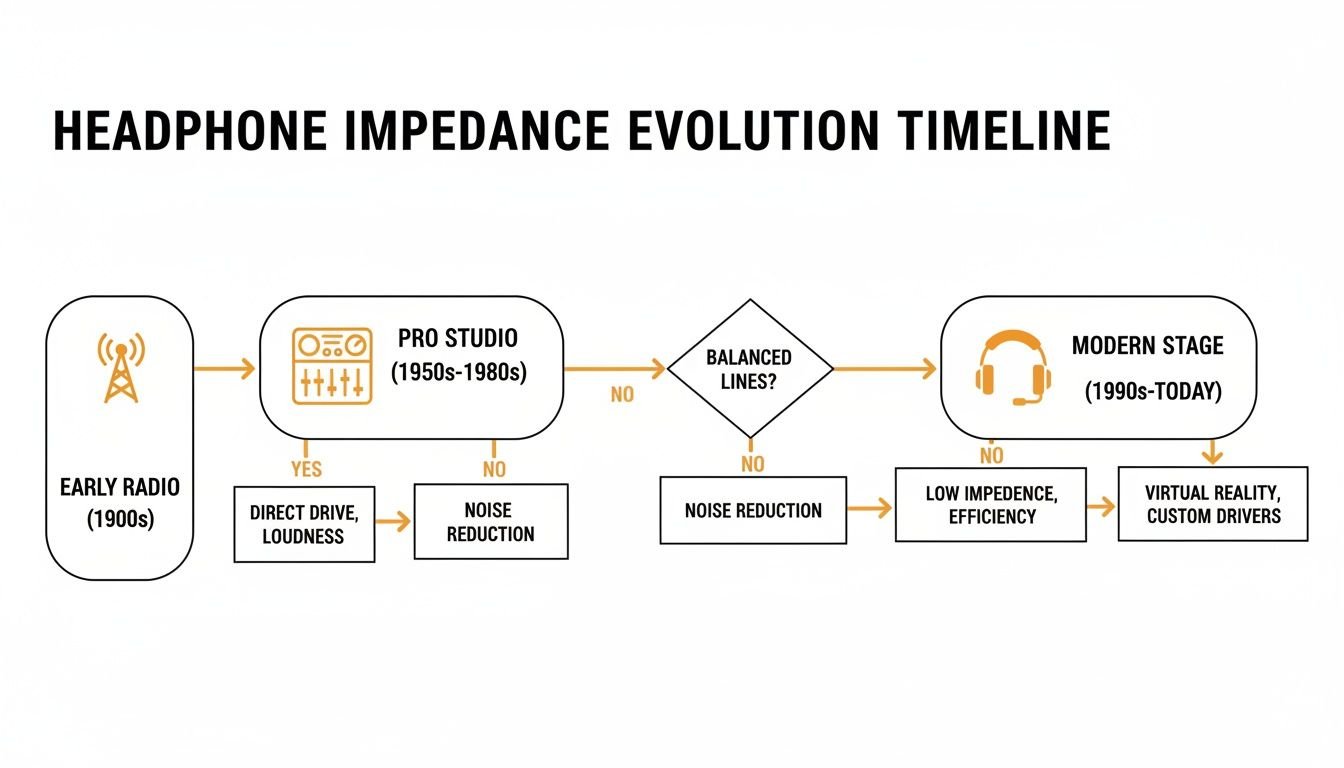
As you can see, what started as an engineering necessity for early electronics became a standard for building robust, high-performance gear for professional environments.
Finding the Perfect Match
So how do you get your pro-level headphones to work with a lower-power source? The answer is often a dedicated headphone amplifier. It acts as the perfect middleman, taking the signal from your source and delivering the right amount of power to drive your high-impedance headphones correctly.
For live sound and studio professionals, the best approach is to match your gear from the start. Professional mixers like the Allen & Heath SQ and Qu series are engineered with headphone outputs powerful enough to drive high-impedance models, delivering the clarity and headroom you need for critical monitoring.
To make things easy, we’ve put together this quick reference table. Use it to quickly determine which headphone impedance range is best suited for your audio device to achieve optimal volume and audio quality.
Headphone and Audio Source Matching Guide
| Headphone Impedance Range | Typical Devices (Audio Source) | Performance Outcome | Recommended for |
|---|---|---|---|
| Under 50Ω | Smartphones, Laptops, Tablets, Wireless IEM Packs | Gets loud easily with low power. Risks distortion or damage with pro-level outputs. | Casual listening, musicians using personal monitoring systems. |
| 50Ω – 100Ω | Prosumer Audio Interfaces, Some Mixers, Drum Machines | A versatile sweet spot that works reasonably well with most sources. | Home studios, drummers, keyboardists, semi-pro applications. |
| Over 100Ω | Professional Mixers, Dedicated Headphone Amps, Studio Outboard Gear | Requires high power to drive properly. Delivers clean, detailed audio at high volumes without distortion. | Critical mixing, studio recording, front-of-house engineers. |
Ultimately, choosing the right impedance for headphones is about making sure your gear can work together harmoniously. At John Soto Music, we specialize in helping churches, schools, and performers select road-tested equipment that’s designed to perform flawlessly as a complete system.
Alright, let's move from the technical theory to where the rubber really meets the road. Knowing about impedance is one thing, but applying it correctly is what separates a frustrating setup from a professional, reliable one.
We're going to break down three common scenarios you'll run into constantly—on stage, in a church, or in a school—to see how choosing the right impedance makes all the difference.
Real-World Setups for Stage, Church, and School

The Church Worship Team
Think about a typical Sunday service. You have a sound engineer at the back of the room and musicians on stage. They have completely different jobs and, therefore, completely different monitoring needs.
The Sound Engineer: The person running the board at the Front of House (FOH) position, maybe on a mixer like an Allen & Heath SQ, needs one thing above all: isolation. They have to hear what the recording feed sounds like, not the live sound bouncing around the room. Practical Use: This is the perfect job for high-impedance headphones. A classic pair of 250-ohm Beyerdynamic DT 770 Pro headphones is the industry standard here. The powerful headphone amp built into a professional mixer can drive them with ease, delivering crystal-clear, detailed audio that lets the engineer make critical mixing decisions.
The Musicians on Stage: The worship leader, guitarist, and drummer are a different story. They need to hear their own personal monitor mix while having the freedom to move. Practical Use: Low-impedance in-ear monitors (IEMs) are the only way to go. IEMs like the popular Shure SE series are designed to be incredibly efficient, so they can get loud and clear using the lower-power bodypack receivers that are part of any good wireless system.
The Gigging Band
For a band playing live shows, every member has a unique monitoring requirement. Getting the impedance right is critical to making sure everyone can hear what they need to play their best.
The drummer, for example, is sitting behind a thunderous Mapex drum kit. They need to hear the click track and the rest of the band over all that acoustic noise. A durable, high-isolation set of high-impedance headphones is their best friend. Plugged into a dedicated headphone amp, they can get all the volume and clarity they need to stay locked in.
Meanwhile, the lead singer needs to roam the stage freely, hearing their vocals perfectly the entire time. A low-impedance wireless IEM system is the clear choice. The low impedance ensures their bodypack receiver can efficiently drive the earpieces, giving them a consistent, cable-free monitor mix no matter where they go.
Pro Tip: In a setup with mixed headphone types, you have to be careful. Never, ever plug low-impedance IEMs directly into a high-power headphone output designed for 250-ohm cans. You'll send way too much power to them, which can cause nasty distortion and even permanently fry the sensitive drivers in the IEMs.
The School Music Lab
When you're outfitting a school music lab, the gear has to be three things: tough, reliable, and student-proof. Whether it’s a keyboard lab full of Nord synthesizers or a digital music classroom, headphone impedance is a key part of making a smart, long-lasting investment.
This is the perfect application for mid-impedance headphones, right around 80 ohms. They strike the perfect balance. They’re robust enough to handle the powerful outputs from keyboards and audio interfaces without getting blown out like cheap consumer earbuds.
At the same time, they aren't so power-hungry that every single station needs its own expensive, high-power amp. This makes them a fantastic, cost-effective, and durable solution for any educational setting. It's a choice that protects the school's investment and guarantees students have reliable gear that will last for years.
Of course! Here is the rewritten section, designed to match the specified human-like, expert style.
How to Troubleshoot Common Impedance Problems
So, you've done your homework, but something still sounds… off. Don't worry, it happens to everyone. When your headphones aren't performing as expected, a classic impedance mismatch is almost always the gremlin in the system. Let’s walk through the most common scenarios we see and how to fix them with practical solutions.
Problem: "My new professional headphones are so quiet!"
This is, without a doubt, the number one issue we get calls about, especially when someone upgrades to a serious pair of professional headphones. The Scenario: You just unboxed some beautiful 250-ohm studio cans, plugged them into your laptop or phone, cranked the volume to max, and… nothing. The sound is weak, thin, and frustratingly quiet.
The Cause: Your high-impedance headphones are starved for power. The tiny, low-power amplifier inside a smartphone or laptop is designed for low-impedance earbuds (usually under 50Ω). It simply doesn't have the electrical muscle—the voltage—to push a signal through the higher resistance of your 250-ohm headphones.
The Solution: You need to give your new headphones the power they need to perform. The fix is a dedicated headphone amplifier. This essential device sits between your audio source (like your laptop) and your headphones, providing the proper voltage to drive high-impedance models to their full, glorious potential. It’s the difference between a whisper and a roar.
Problem: "My audio sounds distorted and crackly through my IEMs!"
Here’s the opposite problem. The Scenario: You plug your low-impedance in-ear monitors (IEMs) directly into the headphone jack of a powerful mixing console, and the sound is a nightmare—harsh, distorted, and painfully loud, even with the volume knob barely turned up.
The Cause: Your low-impedance headphones are being completely overpowered. A professional mixer's headphone output is built to drive high-impedance headphones, so it pushes a ton of voltage. When your 32-ohm IEMs get hit with that much power, their delicate drivers are overloaded, causing them to clip and distort horribly.
Warning: This isn't just a sound quality problem; it's a real safety risk. Blasting that much power into low-impedance headphones can permanently fry their internal components. You can literally melt your drivers, which is a very expensive mistake.
The Solution: Always use the right tool for the job. If you're using IEMs with a mixer, you must connect them to a bodypack receiver from a wireless IEM system or a dedicated personal monitor mixer. These devices are specifically designed to deliver the correct, lower-power signal that low-impedance gear expects, giving you a clean, safe, and clear mix.
This whole professional vs. consumer impedance divide has a long history, rooted in early electronics and safety standards. The bottom line is that pro gear was built for pro headphones. A 32-ohm IEM plugged into a hot mixer output can easily clip at a dangerous 110dB SPL, while a 250-ohm headphone will perform beautifully. Making sure you have the right impedance for your headphones is non-negotiable for clean, safe monitoring. You can actually learn more about the evolution of headphone impedance and its safety implications if you want to dive deeper into the history.
At John Soto Music, we see these kinds of mismatches all the time. It’s exactly why we don't just sell products; we help our clients build complete, perfectly matched systems. From the Allen & Heath mixer in the booth to the IEMs on stage, we make sure every single component is designed to work together flawlessly.
Finding Your Perfect Headphones at John Soto Music
Alright, we’ve covered the theory, looked at real-world scenarios, and walked through how to fix common problems. Now it's time to take all that knowledge and put it to work finding the right headphones for your specific job. Making sense of impedance for headphones is that final, critical step before you can make a purchase you’ll be happy with for years to come.
Let’s translate everything we've talked about into a straightforward, practical buying guide. We’ll connect your role to the right kind of gear, pulling from the road-tested solutions we trust and recommend at John Soto Music.
Match Your Role to the Right Impedance
The ideal headphone impedance really comes down to what you’re doing day-in and day-out. Are you behind a mixing console, performing on a stage, or setting up a practice room? Each of these jobs has a perfect match.
For the Front-of-House Engineer: If you're mixing on a professional console, your best bet is a pair of high-impedance, closed-back headphones. A 250-ohm model is a fantastic choice here. It gives you the clear sonic detail and isolation needed to make critical mix decisions, and it's a perfect electrical match for the powerful headphone amps built into pro mixers.
For the Performer on Stage: Vocalists, guitarists, and keyboard players need to hear themselves clearly without being tied down. This is where low-impedance in-ear monitor (IEM) systems shine. They are incredibly efficient, which means they get plenty loud and clear from the low-power wireless bodypacks musicians wear, delivering a consistent mix no matter where you move on stage.
For the Student or Educator: In a school music lab filled with keyboards like the durable Nord line or a practice room with a Mapex drum kit, you need headphones that are tough and easy to power. Mid-impedance models, typically around 80 ohms, are the sweet spot. They’re robust enough to handle daily use and don't require a dedicated, expensive amplifier for every single station.
The John Soto Music Difference
Picking the right headphones isn’t just about a number on a spec sheet. It’s about making sure every piece of your audio system—from the mixer to the cables to your ears—works together without a hitch. That’s where we come in.
At John Soto Music, we don’t just sell boxes. We provide complete, road-tested solutions. With expert support, fast shipping, and a commitment to helping you succeed, we ensure you get the right gear for the job every time.
Ready to find your perfect audio match? Our team of experts is here to help you navigate the options and select the ideal headphones for your specific needs, guaranteeing you get the performance and reliability you deserve.
Browse our handpicked selection of professional headphones or chat with an expert to find your perfect match today!
Common Questions About Headphone Impedance
We get these questions all the time, so let's clear up some of the most common points of confusion around headphone impedance. This should help you sidestep any lingering doubts and choose your gear with confidence.
Can I use high-impedance headphones with my phone?
Not without some help, you can't. Your phone’s built-in headphone jack just doesn't have enough juice to power them properly. You'll need a dedicated portable headphone amp to give them the voltage they need to sound right.Does higher impedance mean better sound quality?
Not on its own, no. "Better" sound quality comes from a great match between your headphones and the audio source driving them. A perfect match is what delivers incredible sound, regardless of the exact impedance number.What's the best impedance for mixing?
In the pro audio world, the 80 to 250-ohm range is really the sweet spot. Headphones in this range offer the best all-around compatibility and performance with the gear we use every day, like professional mixing consoles and audio interfaces.
At John Soto Music, we're all about helping you find the perfect match for your equipment. Take a look at our hand-picked selection of professional audio gear and let's build a system that sounds phenomenal.