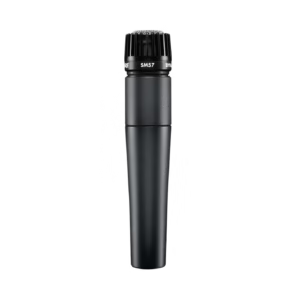
The Audix D6X is the next-generation evolution of the legendary D6 kick drum microphone, adding three switchable voicing profiles to deliver unprecedented versatility. Featuring the same proprietary VLM (Very Low Mass) diaphragm technology as the classic D6 with a frequency response of 25Hz–17kHz, the D6X includes a 3-position switch that selects Deep (classic D6 sound), Balanced (more mids/upper mids), or Natural (linear response for percussion and guitar cabs). Perfect for kick drums, floor toms, bass cabinets, and beyond, it handles 144dB SPL and is designed, machined, assembled, and tested in the USA. Backed by Audix’s 5-year warranty on VLM dynamic microphones.
The D6X: Three Mics in One Body
The Audix D6X takes everything engineers love about the classic D6—the punch, the low-end thump, the minimal EQ needed—and adds three voicing options via a simple recessed switch. The bottom position (Deep) is 100% the classic D6 sound that’s been the industry standard for modern kick drums. The center position (Balanced) provides more mids and upper mids for a slightly more traditional kick drum tone. The top position (Natural) delivers a more linear response with enhanced midrange, making it useful on percussion instruments, guitar cabinets, snare drums, rack toms, and even vocals.
According to Sound on Sound’s review: “Natural mode is something of a revelation. It still has plenty to offer on percussive sources, and if it’s not sculpted enough to produce your kick drum sound of choice, it’s very much worth trying out on snare and rack toms. It even turns the D6X into a surprisingly effective vocal mic, as long as you don’t mind its low sensitivity.” This versatility means you’re not locked into one sound—the D6X adapts to what the session needs.
The D6X uses the same VLM (Very Low Mass) diaphragm as the original D6, which means transient response and SPL handling are identical. You get the fast attack that captures beater strikes and the low-frequency extension down to 25Hz (extended from the D6’s 30Hz) that captures chest-hitting thump. One user in a drum mic shootout described finding the D6X perfect after feeling the original D6’s voicing was too strong: “As if Audix guessed what I wanted, the D6X has 3 levels of frequency response voicing from weak to medium to strong which corresponds to the D6. Absolutely perfect and made for me.”
Who Uses the D6X and Why
The D6X is designed for drummers, engineers, and sound professionals who need one kick mic that handles multiple situations. If you’re tracking different musical styles in the studio—rock one day, jazz the next, metal after that—the D6X gives you appropriate voicing for each without owning three different mics. The Deep setting delivers aggressive modern kick drum tone for rock and metal. The Balanced setting works for pop, country, and styles where you want less extreme EQ. The Natural setting handles acoustic styles, percussion, and alternative applications.
For live sound engineers working with multiple bands in one night, the D6X adapts to different drummers and musical styles quickly. Just flip the switch to match the sound the music needs. One Sweetwater comparison video between the D6 and D6X demonstrated how the three settings give you different starting points that would otherwise require different mics or extensive EQ work. The flexibility matters when you’re working under time pressure.
Engineers who already own and love the D6 can add the D6X to expand their options. The Deep setting is sonically identical to the D6, so you’re not replacing your favorite sound—you’re adding two more. The D6X works alongside your D6, not instead of it. For those new to Audix, the D6X gives you everything the D6 offers plus more versatility for the same price point as buying a D6 and another kick mic.
The Three Voicing Positions Explained
Deep (bottom position) is the classic D6 frequency response—14dB boost at 60Hz for low-end thump, significant attenuation from 90-600Hz to scoop the mids, and presence peaks between 4-12kHz for beater attack. This aggressive voicing gives you that “mix-ready” modern kick drum sound that cuts through dense arrangements without fighting for space. If you know you want the D6 sound, this is it. Perfect for kick drums and bass cabinets in rock, metal, pop, and contemporary production.
Balanced (center position) retains some of the D6’s character but brings back more mids and upper mids. The “smiley face” EQ curve is still there but less extreme. Sound on Sound noted: “I am not sure that Balanced mode sounds balanced on anything other than a bass drum, but there, it often seems to replicate the EQ moves I’d want to make on a general‑purpose mic such as a beyerdynamic M88.” This setting works when you want kick drums with body and punch but more natural tonal balance. It’s also useful on floor toms where the Deep setting might be too scooped.
Natural (top position) moves toward a more linear frequency response with even more midrange and adjusted high-end rolloff. This opens up the D6X for applications beyond kick drums. The Sound on Sound reviewer found it works surprisingly well on snare drums, rack toms, and even vocals. Users report success on Latin percussion, guitar cabinets (especially on the lower driver of rotary organ speakers), and any source where you want extended low-frequency response without extreme EQ coloration. This is the “Swiss Army knife” setting that makes the D6X more than just a kick mic.
VLM Diaphragm Technology
The D6X uses the same VLM (Very Low Mass) diaphragm as the original D6. This proprietary Audix technology uses an extremely lightweight diaphragm that reacts instantly to sound pressure, capturing transient information that heavier diaphragms miss. For kick drums, this means you get both the initial beater impact and the low-frequency resonance of the drum. The diaphragm moves fast enough to track rapid attacks while still handling massive amounts of low-frequency energy.
The VLM capsule handles 144dB SPL without distortion. That’s more than enough for any acoustic drum kit, even with the hardest-hitting metal drummers. You can position the D6X inside a kick drum directly in the path of the beater or on a loud bass cabinet at full volume, and the mic won’t overload. The high SPL handling combined with the VLM diaphragm means you capture loud sources cleanly without the compression or distortion that happens when mics are pushed past their limits.
The sensitivity is intentionally low (0.8mV/Pa measured at 75Hz instead of the usual 1kHz test tone) so the mic won’t overload preamps and converters even when placed inside loud kick drums. This design choice means you typically don’t need pads or attenuators—just plug directly into your preamp and adjust gain normally. Engineers appreciate not having to worry about managing hot signals from kick drums.
Build Quality and USA Manufacturing
The D6X is designed, machined, assembled, and tested at Audix’s facility in Wilsonville, Oregon. The body is precision-machined from solid aluminum, creating a one-piece housing that’s both lightweight and durable. The black anodized finish with textured matte surface gives it an elegant, professional appearance. When you pick up the D6X, it feels substantial—the weight and build quality communicate that this is serious professional equipment.
The 3-position switch is recessed into the body to prevent accidental changes during use but can still be adjusted without tools. Just use your finger or a pen tip to flip between settings. This design means the switch won’t get bumped during transport or performance, but you can still change voicing quickly when needed. The switch mechanism feels solid and clicks definitively into each position.
The transformerless output circuit with 200-ohm impedance minimizes signal loss and eliminates interference even on very long cable runs. The gold-plated XLR connector ensures reliable connections and resists corrosion. The cardioid polar pattern (leaning toward supercardioid at most frequencies) provides good off-axis rejection to isolate the kick drum from other kit pieces. Audix specs show >20dB of off-axis rejection, which helps keep cymbals and other drums out of the kick mic.
Real-World Applications Beyond Kick Drums
While the D6X is primarily a kick drum mic, the Natural setting opens up other applications. Sound engineers have successfully used it on floor toms where the Balanced setting provides punch without the extreme scooping of the Deep setting. On snare drums in the Natural position, it captures body and crack with the extended low-frequency response adding weight that brighter mics miss. For rack toms, the Natural setting works when you want more low-end emphasis than typical tom mics provide.
Guitar cabinet miking is another application where the Natural setting shines. The extended low-frequency response captures the fullness of guitar tones, particularly useful for down-tuned guitars or bass-heavy styles. One user specifically mentioned using it on “the lower driver of a rotary organ speaker” in Natural mode, capturing the low-frequency output that other mics don’t handle as well. For Latin percussion like congas, djembes, and cajons, the Natural setting provides balanced tone with extended lows.
The D6X also works on bass cabinets in any of the three positions. Deep gives you aggressive, cut-through-the-mix bass tone for rock and metal. Balanced provides more traditional bass sound with body and definition. Natural delivers more neutral bass capture for jazz, acoustic, or styles where you want less EQ coloration. Having three options from one mic means you can adapt to what the music needs without carrying multiple bass mics.
Connectivity and Setup
The D6X has a 3-pin gold-plated male XLR connector. It’s a dynamic mic, so no phantom power required—just plug in and go. The transformerless design with 200-ohm output impedance works with any standard mic input and maintains clean signal even on stages with 100-foot cable runs. The low impedance helps reject interference from lighting systems, power cables, and other sources of electrical noise.
Setup is straightforward. Position the D6X where you want it (inside the drum, at the port, or outside), select your voicing (Deep for aggressive modern sound, Balanced for more traditional tone, Natural for alternative applications), plug in your XLR cable, and adjust gain. The mic doesn’t come with a dedicated clip, but its compact size and barrel diameter work with standard mic clips. The VLM capsule is sensitive, so Audix recommends storing the mic in the provided pouch and avoiding extreme temperatures.
What to Know Before Buying
The D6X has intentionally low sensitivity, which means you’ll need more preamp gain than with some other kick mics. This design choice prevents overloading preamps and converters when the mic is placed inside loud kick drums, but it means you need decent preamps with adequate gain. Most modern interfaces and mixers handle this fine, but if you’re using older equipment with low-gain preamps, you might need a preamp boost like a Cloudlifter.
The VLM capsule is highly sensitive to physical handling, so Audix recommends storing the mic in the provided pouch and avoiding extreme temperatures or moisture. This isn’t a “throw it in a road case and forget about it” mic like an SM57—it needs reasonable care. The aluminum housing protects the capsule, but dropping the mic or subjecting it to impacts can affect performance. Treat it like the professional tool it is.
The three voicing options are useful, but they’re not infinitely adjustable. You get three specific sounds—Deep, Balanced, Natural—and that’s it. If you need something between Balanced and Natural, you’ll need to use EQ. The voicing switch gives you three excellent starting points, but it’s not a substitute for proper mixing and EQ when needed. Think of the three positions as giving you three different mics, not infinite tonal variations.